Client: A mid-sized manufacturer of single-use medical consumables. Service line: Strategic Growth Solutions.
At a glance
200+ hours of line observation
Defect rate down by around 60%
Unplanned downtime down by more than three-quarters
Fee recouped within weeks of go-live
The question
Output was growing but margin was not. Where was value leaking, how much was it worth, and what would stop it for good?
The situation
The manufacturer, certified and exporting to hospital buyers, had a credible market position but a widening gap between output and margin. Defects were running at roughly twice the industry benchmark, the main line stopped several times a week, raw material was over-dispensed with no recovery loop, and quality, production and procurement each reported from separate spreadsheets.
Our approach
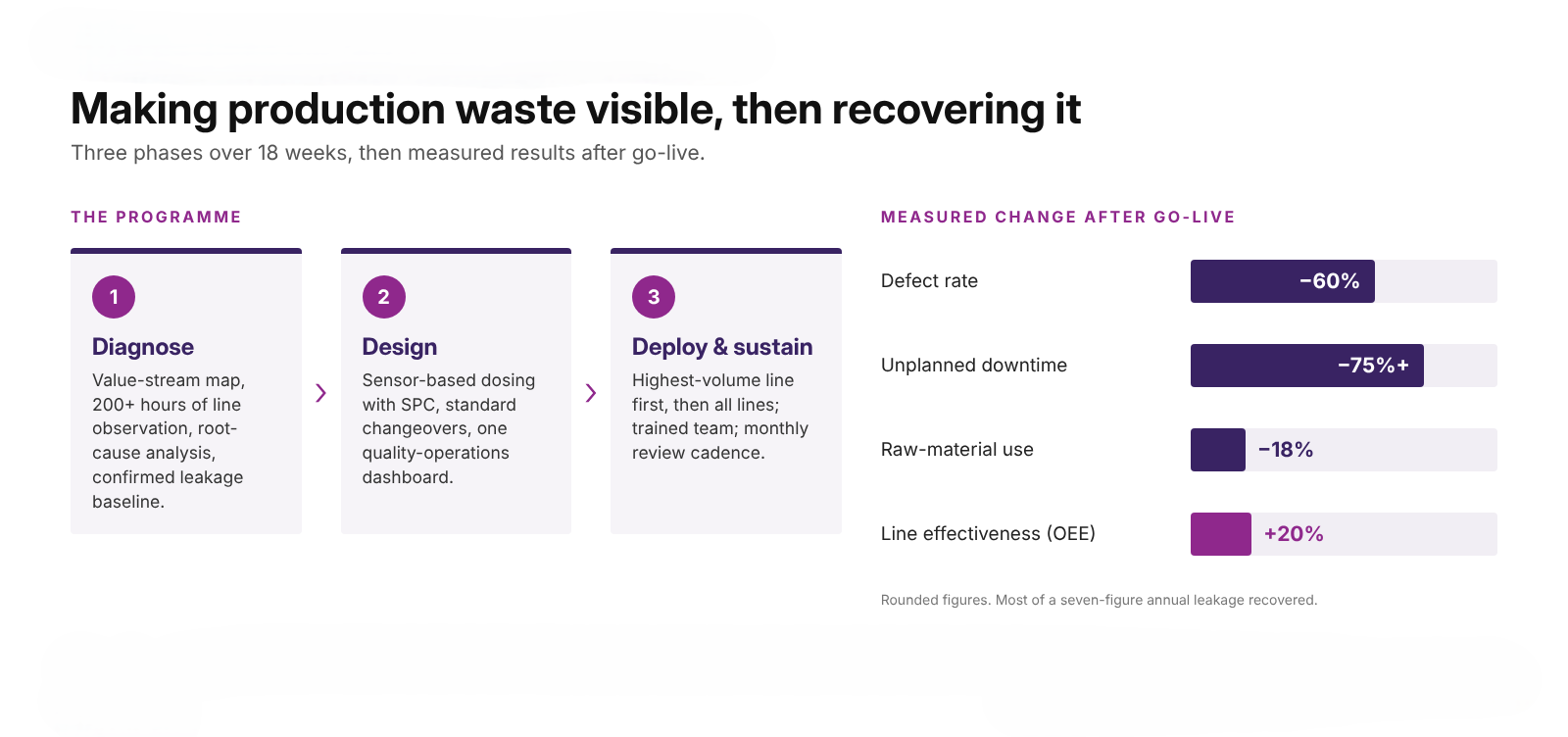
Diagnose (weeks 1-5): value-stream mapping of every production line; time-and-motion study over 200+ observation hours; Pareto and Ishikawa analysis of quality failures; supplier input-variance audit; a confirmed annual value-leakage baseline.
Design (weeks 6-11): sensor-based raw-material dosing with statistical process control; changeover and cleaning standardised using SMED; FMEA on every redesigned process before go-live; a supplier qualification framework.
Deploy and sustain (weeks 12-18): rollout on the highest-volume line first, then all lines; 5S at maintenance and inspection areas; a cross-functional improvement team trained in Lean and root-cause methods; a monthly operational-excellence review.
Every change was agreed in weekly steering with plant leadership and with the operators who would run it, so adoption was built in rather than enforced.
What we delivered
A diagnostic baseline of value leakage, broken down by category and line, with owners for each loss.
Redesigned dosing, changeover and cleaning standards, with control charts for critical parameters.
One dashboard for quality, equipment effectiveness (OEE) and material consumption.
A supplier qualification framework and a trained internal team to sustain the gains.
A sustainment package: control plans, review templates and a 90-day follow-up check on every improvement.
What we found
No single failure explained the loss; it was many small losses that no single dashboard showed.
Unplanned stoppages traced mainly to inconsistent changeover and cleaning, not to equipment.
Over-dispensing of raw material was invisible because consumption was never reconciled with output.
What changed
Measured after implementation: defect rate down by around 60%, unplanned downtime down by more than three-quarters, raw-material consumption down by around 18% and line effectiveness up by around 20%. Most of the confirmed seven-figure leakage was recovered annually, and the engagement fee was recouped within weeks of go-live.
What it shows
Value leakage in manufacturing is rarely one big failure; it is many small losses that no single dashboard shows. Making them visible in one baseline turns improvement from opinion into a business case, and governance keeps the gains.
Facing a similar question? Talk to us about it.
Case notes are anonymised. Client names, figures and identifying details are withheld or generalised.