Client: A global biopharmaceutical company, through a UAE-based healthcare capability partner. Service line: Strategic Growth Solutions.
At a glance
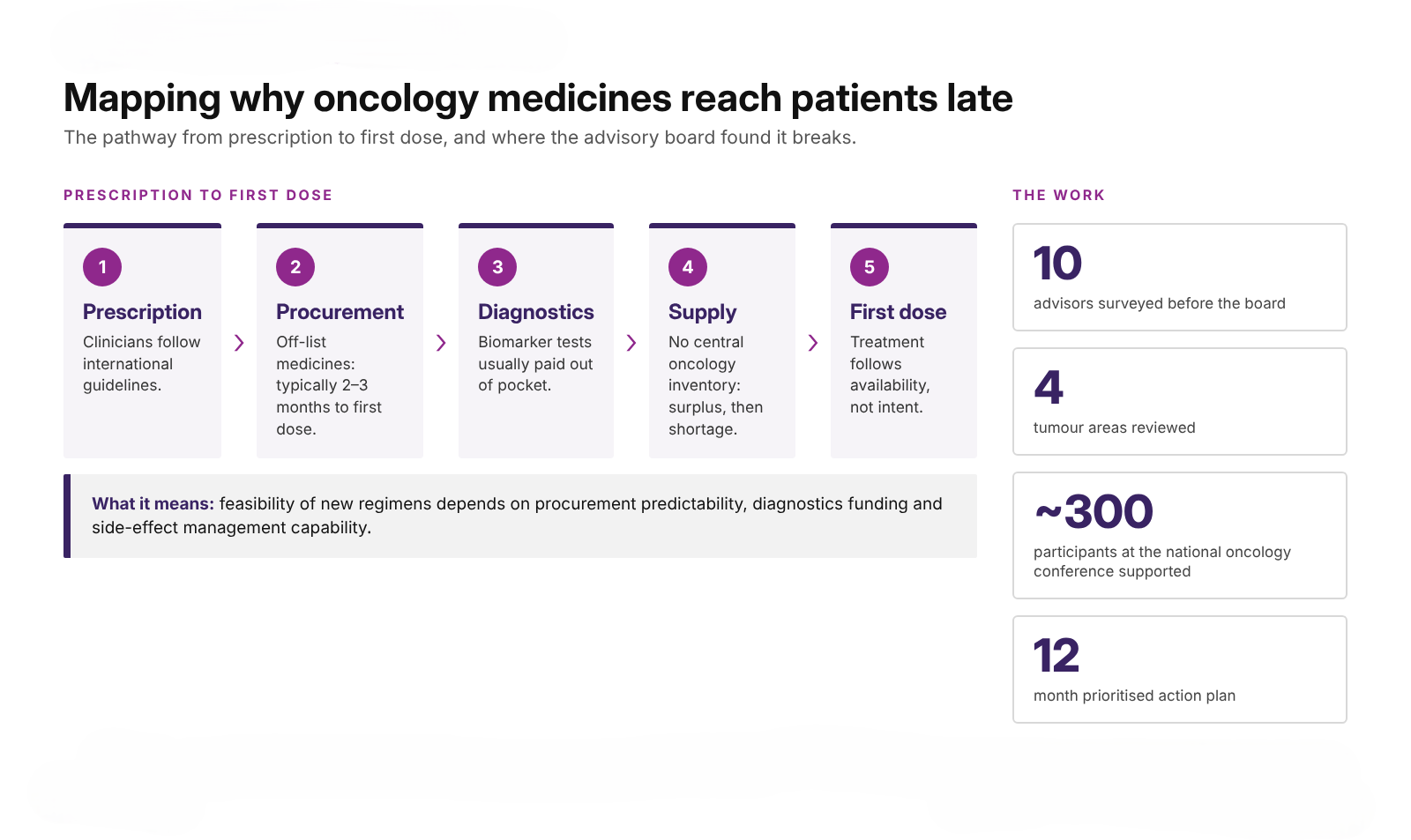
10 senior oncology advisors from the main regions of the country
4 tumour areas: lung, kidney, liver and colorectal cancer
4 analytical methods, cross-checked against published sources
A prioritised 12-month action plan, plus a national conference of ~300 participants
The question
Ahead of introducing newer immunotherapy combinations in a North African market, a global biopharmaceutical company needed to know where the pathway from prescription to first dose breaks, and which fixes would move patient access within a year.
The situation
Clinicians in the market were well versed in international guidelines and saw clear value in newer immunotherapy combinations. Yet real-world prescribing told a different story. The company needed evidence that went beyond opinion: a structured, defensible view of how access actually works, region by region, and of the system constraints that would decide whether a new regimen could be started and, critically, completed.
Our approach
Before the board, aligned objectives, compliance rules and the questions each module had to answer with the client's cross-functional leads.
Designed the advisory board end to end: objectives, discussion guide, four structured modules (health-system structure and three tumour-specific modules) and a round-robin format so every region had an equal voice.
Ran a pre-meeting quantitative survey of all ten advisors to capture caseloads, practice patterns, access routes and time-to-treatment, then cleaned the data under documented rules before analysis.
Analysed the recorded sessions with four complementary methods: thematic analysis to surface recurring constraints, content analysis to quantify how often each issue arose, narrative analysis to trace real patient journeys, and framework analysis to map every finding onto the access pathway.
Triangulated the advisors' input with secondary desk research across published sources, confirming points of agreement and flagging discrepancies so the client could see where testimony and published evidence diverged.
Anonymised and coded all advisor input under compliance protocols, linking every insight to its evidence: survey result, transcript reference or published source.
What we delivered
An evidence-graded access blueprint: executive summary, method and data-cleaning log, participant profile, module-by-module findings with the evidence behind each, and strategic implications.
A prioritised 12-month action plan focused on the system enablers advisors rated as both high-impact and achievable.
Scientific programme support for a national oncology conference of around 300 multidisciplinary participants, including a dedicated kidney-cancer symposium, followed by a field-insights brief that fed the client's planning.
An executive debrief that turned each finding into an owner and a next step.
What we found
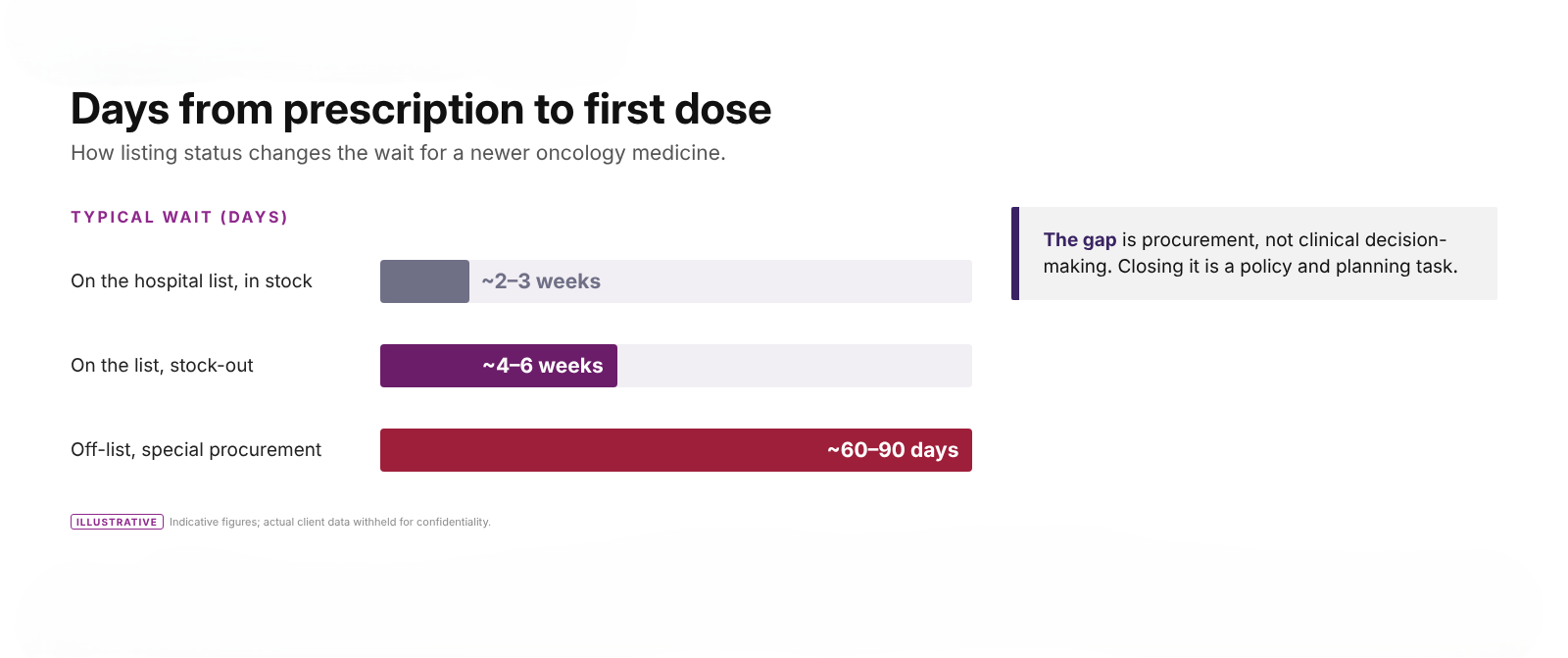
Procurement, not clinical intent, sets the pace: for medicines outside the national list, time to first dose was most often two to three months, and direct purchase was mainly a workaround for off-list status and tender delays.
Decision authority was fragmented across national, ministerial, procurement and hospital levels, which explained much of the site-to-site variability.
There was no central oncology inventory, so supply swung between surplus and shortage, and the most damaging outcome was a regimen started but not completed.
Biomarker testing was the single biggest bottleneck for precision oncology: largely unavailable in the public sector and usually paid out of pocket, adding weeks before treatment could begin.
Side-effect management capability and multidisciplinary pathways, not awareness of guidelines, determined whether newer combinations were feasible.
Access differed materially by region and centre, so national assumptions had to give way to centre-level mapping; and clinicians lacked a single, organised voice in national decisions.
What changed
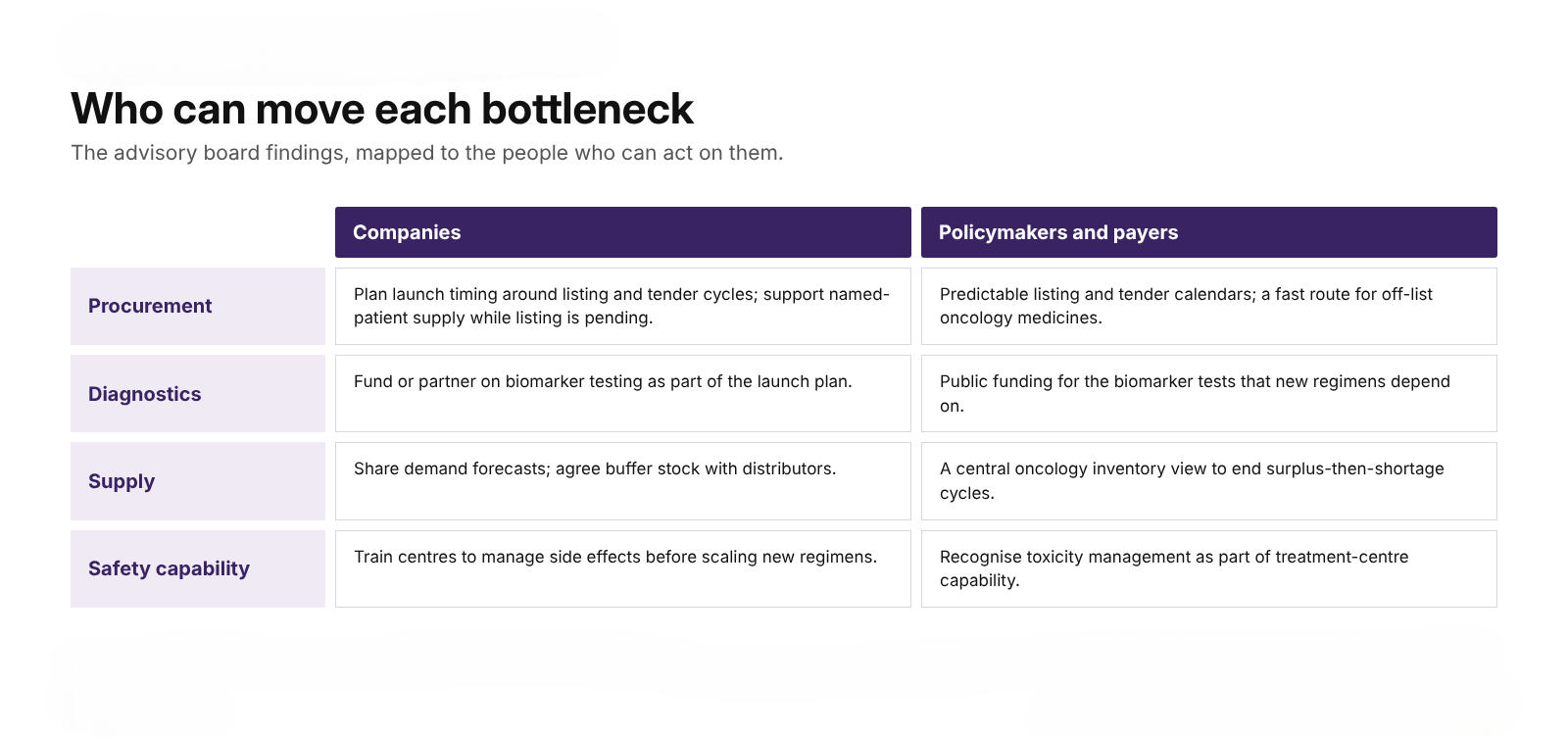
The client moved from a product-listing mindset to a system-partnership agenda: reference-laboratory models for key biomarker tests, standard procedures for managing immune-related side effects across specialties, and demand forecasting and inventory visibility aligned with the national authority's decision logic. Each was rated by advisors as achievable within twelve months with coordinated support.
What it shows
Access is an execution system, not a label decision. For companies it means planning diagnostics, supply continuity and safety capability alongside the launch. For policymakers it points to procurement predictability and diagnostic funding as the levers that move patient outcomes fastest.
Facing a similar question? Talk to us about it.
Case notes are anonymised. Client names, figures and identifying details are withheld or generalised.