Building a distributor multinationals can trust
Designing the minimum viable organisation a distributor needs before rare-disease multinationals will partner with it.
Thank you for subscribing
Thank you for subscribing
Thank you for subscribing



Client: A North African healthcare distributor building a rare-disease partnership business. Service line: Strategic Growth Solutions.
Organisation and every role description reviewed
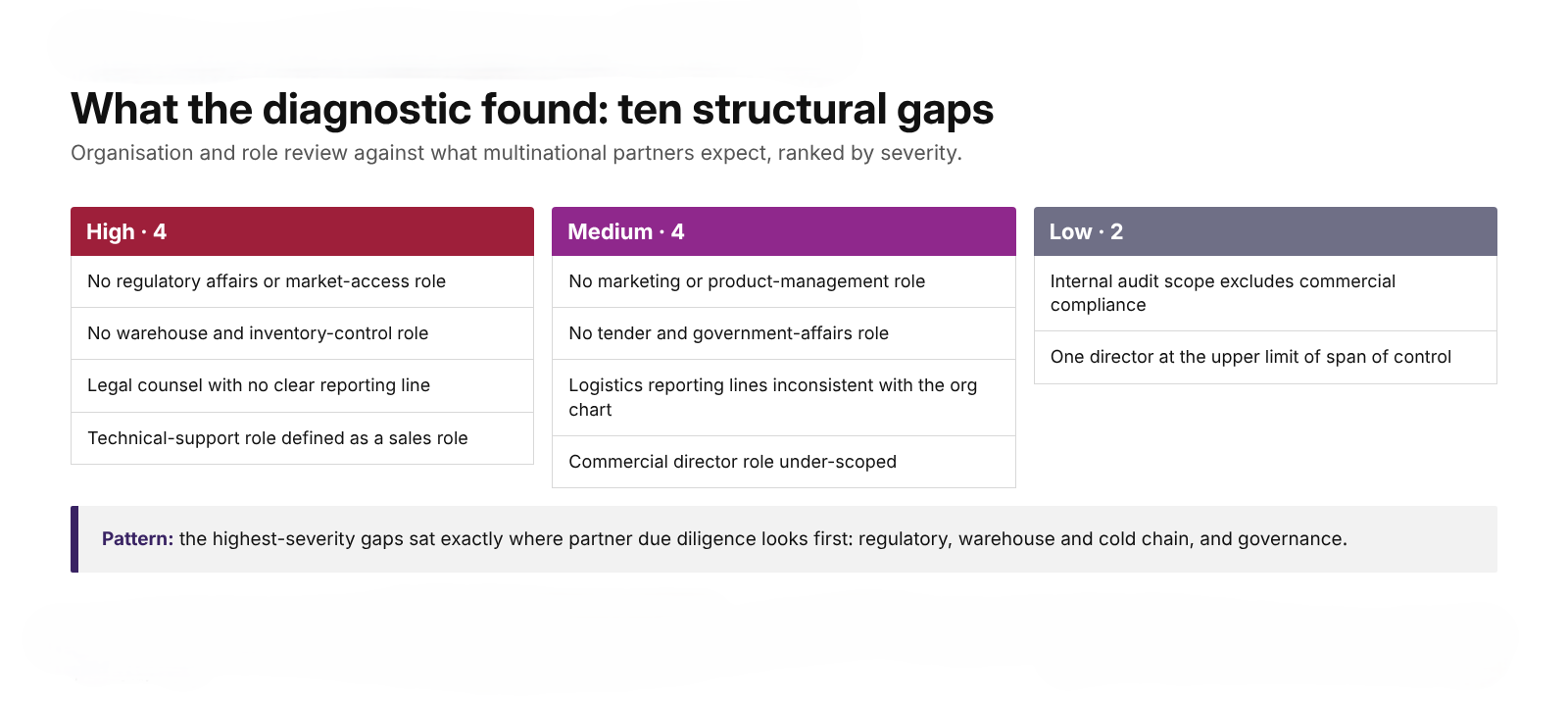
10 structural gaps ranked by severity, 4 of them high
Six-workstream partner-readiness programme designed
Phased hiring and cost curve linked to capability
The distributor wanted to grow beyond tenders into contract-sales and "Distribution+" partnerships with multinational rare-disease companies. What would it take to pass their due diligence, and in what order should it be built?
Rare-disease multinationals expect a partner to run pharmacovigilance, quality systems, regulatory interfaces and compliance to their own standards. The distributor had strong market relationships and an ambitious partner list, but its organisation had grown around tender work: roles were loosely defined, several critical functions were missing, and the documentation a partner's auditors would request did not yet exist.
Opened with leadership workshops to fix scope boundaries and decision rights, so the design started from agreed ground.
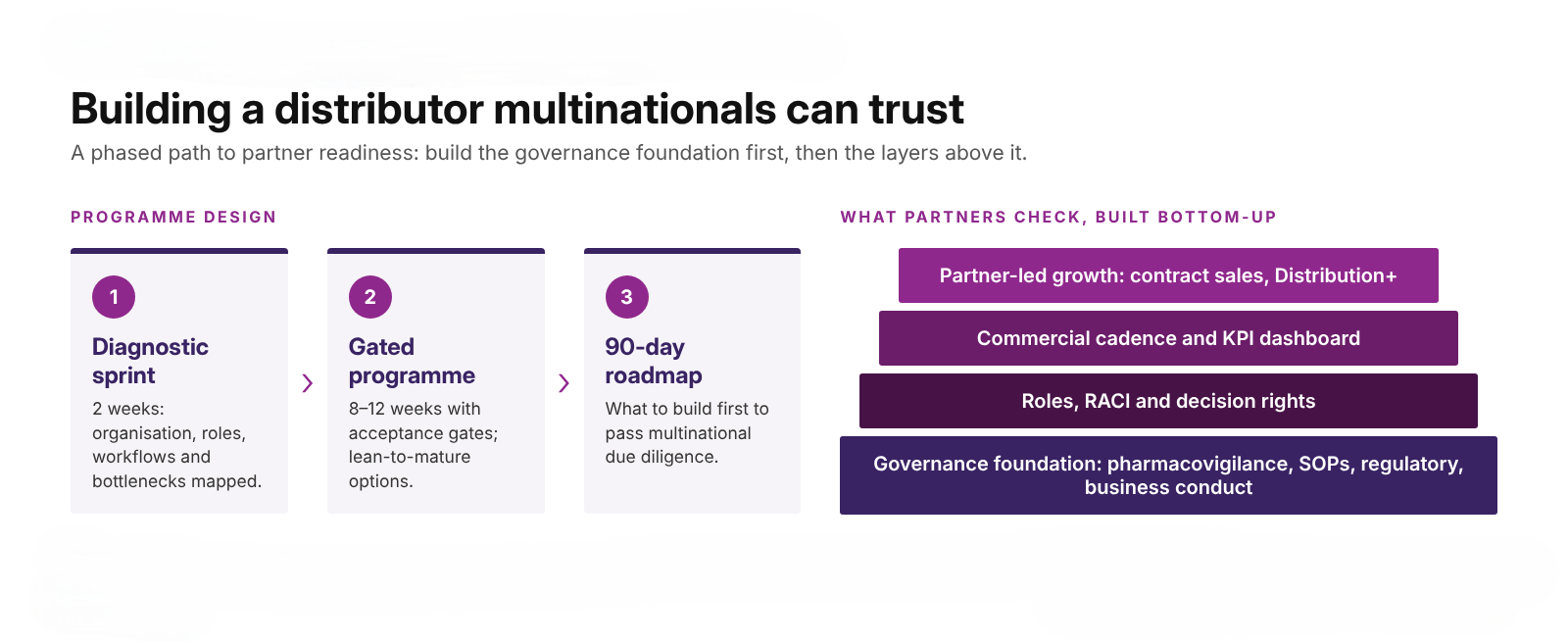
A two-week diagnostic sprint: leadership interviews, review of the draft structure, workflows and decision rights, and mapping of execution bottlenecks.
A role-by-role review of every job description against the operating model, benchmarking tasks to roles (doer, reviewer, approver) and testing grading, spans of control and reporting lines.
Gap and severity assessment against multinational partner expectations in governance, pharmacovigilance, quality, regulatory, commercial capability and finance.
Operating-model design with lean, step-up and mature options, sized to local capability constraints rather than to an ideal end state.
A diagnostic framework of constraints, gaps and opportunities, with a severity-ranked gap analysis and advisory recommendations.
A redesigned organisation structure, proposed organisation chart, standardised job descriptions and a grading and headcount view.
A six-workstream readiness programme: operating model and governance; organisation design and role clarity; a minimum viable pharmacovigilance, quality and compliance baseline (core SOPs, logs and training); a service catalogue for tender versus Distribution+ work; a phased hiring and cost plan; and a partner-ready profile pack.
A 90-day roadmap with owners, milestones and quick wins.
A leadership readout setting out the recommended operating-model option, the trade-offs against the alternatives, and the sequence for building it.
The four highest-severity gaps sat exactly where partner due diligence looks first: no regulatory-affairs or market-access role, no warehouse and inventory-control role, an unclear reporting line for legal counsel, and a technical-support role written as a sales role.
Several job descriptions were copied across roles, making them indistinguishable for grading, recruitment and accountability.
Tender management was fragmented across many roles with no single owner, a material risk in a government-heavy market.
Governance had to come before headcount: hiring ahead of SOPs and decision rights would only scale the gaps.
The distributor gained a clear, prioritised path to partner readiness: what to fix first, what to build next and what it would cost, together with an organisation design it could take into multinational conversations with confidence.
Multinational partners choose on governance as much as on reach. Building the foundation first (pharmacovigilance, SOPs, decision rights) is what turns relationships into contracts.
Facing a similar question? Talk to us about it.
Case notes are anonymised. Client names, figures and identifying details are withheld or generalised.